

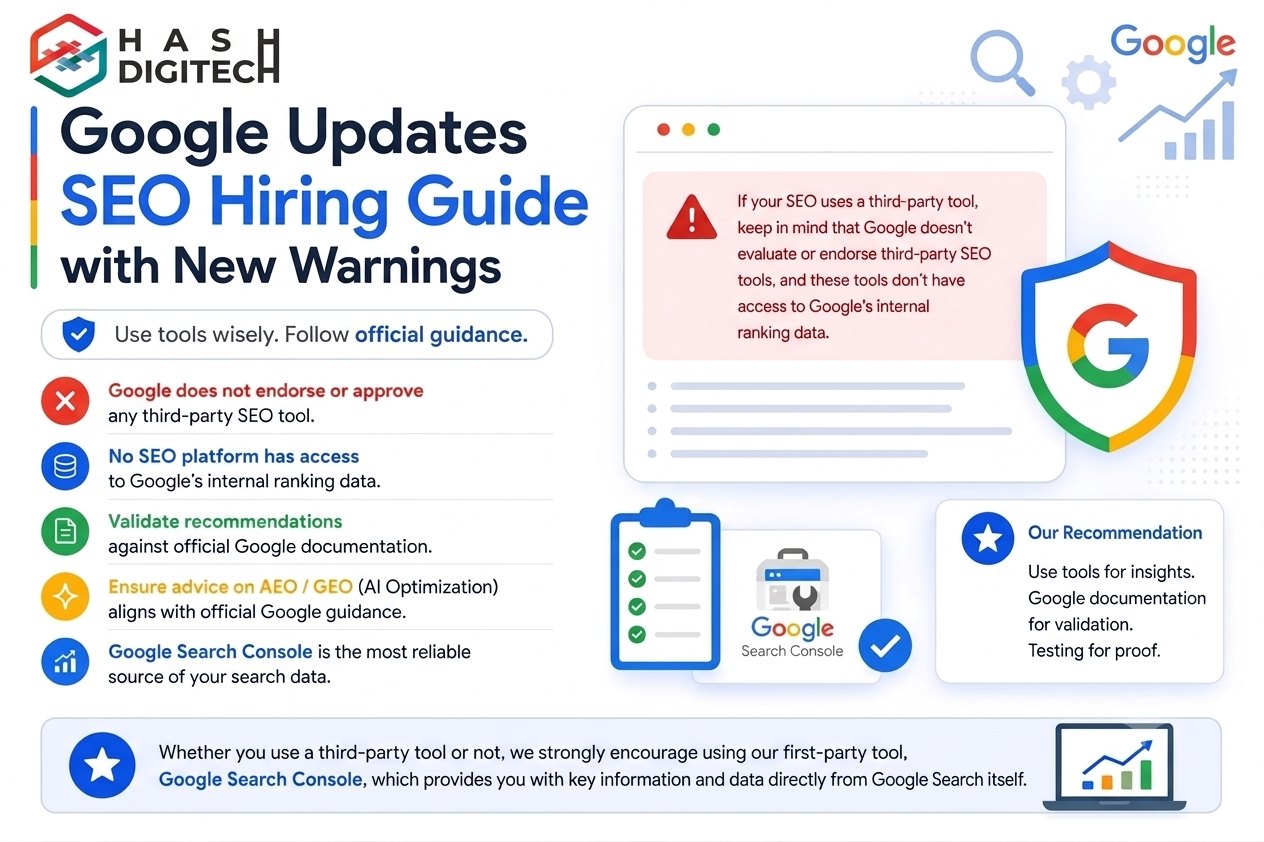
The world of SEO (Search Engine Optimization) is constantly evolving, and third party SEO tools are becoming increasingly advanced. Recently, Google updated its guidance for hiring SEO professionals and agencies and provided an important message:
SEO tools are helpful, but their recommendations should not be blindly followed without verification.
This update does not mean that SEO tools are useless. Google simply wants businesses and marketers to understand that SEO tool data should be used in conjunction with official Google documentation and real-world testing.
What important points did Google share?
-
Google does not endorse any third-party SEO tools.
Google has clarified that it does not officially recommend or approve any SEO tools.
Whether you use SEMrush, Ahrefs, Moz, Ubersuggest, Screaming Frog, or any other SEO software, Google has no official partnership with these tools.
Therefore, businesses should understand that while tool reports may be useful, they should not be considered the ultimate truth.
-
No SEO tool has Google’s internal ranking data.
These days, SEO tools show keyword difficulty, search volume, traffic estimates, and ranking opportunities.
However, Google clearly states that:
No third-party tools have access to Google’s internal ranking signals or algorithm data.
The metrics displayed by these tools are generated based on estimated data and their own algorithms.
Therefore, keyword difficulty or traffic estimates should be used as directional insights rather than exact numbers.
-
Verify SEO Recommendations with Official Google Documentation
Google advises businesses to check official Google documentation before blindly implementing any SEO recommendations.
Sometimes SEO tools provide specific issues or optimization suggestions, but not every recommendation necessarily complies with Google’s guidelines.
A successful SEO strategy is one where there is clear reasoning and validation behind every change.
-
AI Optimization (AEO/GEO) must also be aligned with official guidelines.
With the increasing impact of AI Search and Generative AI, new terms are becoming popular:
- AEO (Answer Engine Optimization)
- GEO (Generative Engine Optimization)
- AI Search Optimization
Google specifically mentions that businesses should ensure their AI optimization strategies align with official Google guidance.
Simply creating content for AI or following the recommendations of AI tools is not enough. Content must also be valuable and helpful to users.
-
Google Search Console is still the most reliable data source
According to Google, the most reliable source for monitoring website performance is still Google Search Console.
Google Search Console provides you with data directly from Google, such as:
- Search Impressions
- Clicks
- Average Ranking Position
- Indexing Status
- Core Web Vitals
- Crawl Errors
This data represents actual Google Search performance, not third-party estimates.
Are SEO Tools Still Important?
Absolutely!
Google hasn’t advised against SEO tools. In today’s competitive SEO environment, the role of tools is crucial.
What are SEO tools useful for?
- Technical SEO Audit
- Helps identify broken links, crawl errors, and technical issues on a website.
- Keyword Research
- Indicates what the target audience is searching for and which keywords can rank.
- Competitor Analysis
- Helps analyze competitors’ SEO strategies and backlinks.
- Rank Tracking
- Regularly monitors keyword rankings.
- Backlink Analysis
- Useful for identifying link building opportunities and monitoring backlink profiles.
What is the formula for successful SEO?
These days, successful SEO isn’t just about tools or experience.
The best SEO results are achieved when you combine:
Data
Insights from SEO tools.
Critical Thinking
Analyze every recommendation and don’t blindly follow it.
Official Google Guidance
Act according to Google’s documented best practices.
What does this mean for SEO agencies and consultants?
After this Google update, agencies and consultants will need to make their recommendations more transparent.
They must clearly communicate to clients:
- Tool data is estimated.
- Every recommendation must be validated according to Google documentation.
- Real-world testing and performance monitoring are essential.
- Focus should be on business growth and conversions, not rankings.
Google’s latest update is an important reminder
SEO tools are powerful, but not perfect.
SEO tools are very useful for research, audits, tracking, and analysis, but official Google guidance, practical experience, and continuous testing are equally important for long-term SEO success.
In today’s AI-driven search environment, only those businesses and marketers will be successful who smartly interpret data and prioritize Google’s best practices, rather than blindly following it.
At Hash Digitech, we believe that successful SEO is achieved not just through tool reports, but through a data-driven strategy, continuous optimization, and Google-approved practices.
What is your opinion? Should agencies and consultants change the way they present tool-based recommendations to their clients after this Google update?
Does Google officially recommend any SEO tools?
No. Google has clarified that it does not officially endorse or recommend any third-party SEO tools. SEO tools are useful, but their recommendations should be verified with Google’s official guidelines.
Do Ahrefs, SEMrush, and Moz have Google’s ranking data?
No. No third-party SEO tool has access to Google’s internal ranking signals and algorithms. These tools provide insights based on their own algorithms and estimated data.
Should I stop using SEO tools?
Absolutely not. SEO tools are very useful for keyword research, competitor analysis, technical audits, backlink analysis, and rank tracking. Google doesn’t recommend avoiding tools, but rather recommends not relying entirely on them.
What is the most reliable data source for SEO?
According to Google, Google Search Console is the most reliable source for monitoring a website’s search performance because it provides real-time data directly from Google Search.
What are AEO and GEO?
AEO (Answer Engine Optimization) and GEO (Generative Engine Optimization) are techniques for optimizing content for AI-powered search results. Their purpose is to improve visibility in AI search engines and generative search experiences.
Should AI-generated SEO recommendations be followed blindly?
No. AI tools and SEO platforms can provide helpful suggestions, but each recommendation must be validated with Google’s official documentation and real-world testing.
What is the difference between Google Search Console and SEO tools?
Google Search Console provides actual search data such as clicks, impressions, and indexing status. SEO tools provide additional insights such as keyword difficulty, competitor analysis, and traffic estimates. For best results, the two should be used together.
Are SEO tools’ keyword difficulty and search volume 100% accurate?
No. These metrics are estimates, and each tool’s calculation method is different. Therefore, they should be used as directional insights rather than exact numbers.
What should businesses look for when hiring an SEO agency?
Business owners should ensure that the agency:u003cbru003eFollows Google guidelinesu003cbru003eUses Search Console and Analytics datau003cbru003eProvides transparent reportingu003cbru003eFocuses on real business results, not just tool reports
What impact will Google’s latest update have on the SEO industry?
After this update, agencies and consultants will be required to present tool-based recommendations in a more transparent manner. Focus will shift to testing, data validation, and Google’s official best practices instead of estimates.

