Is SEO Dead in 2027? AI Search, Zero-Click Results & The Future of SEO
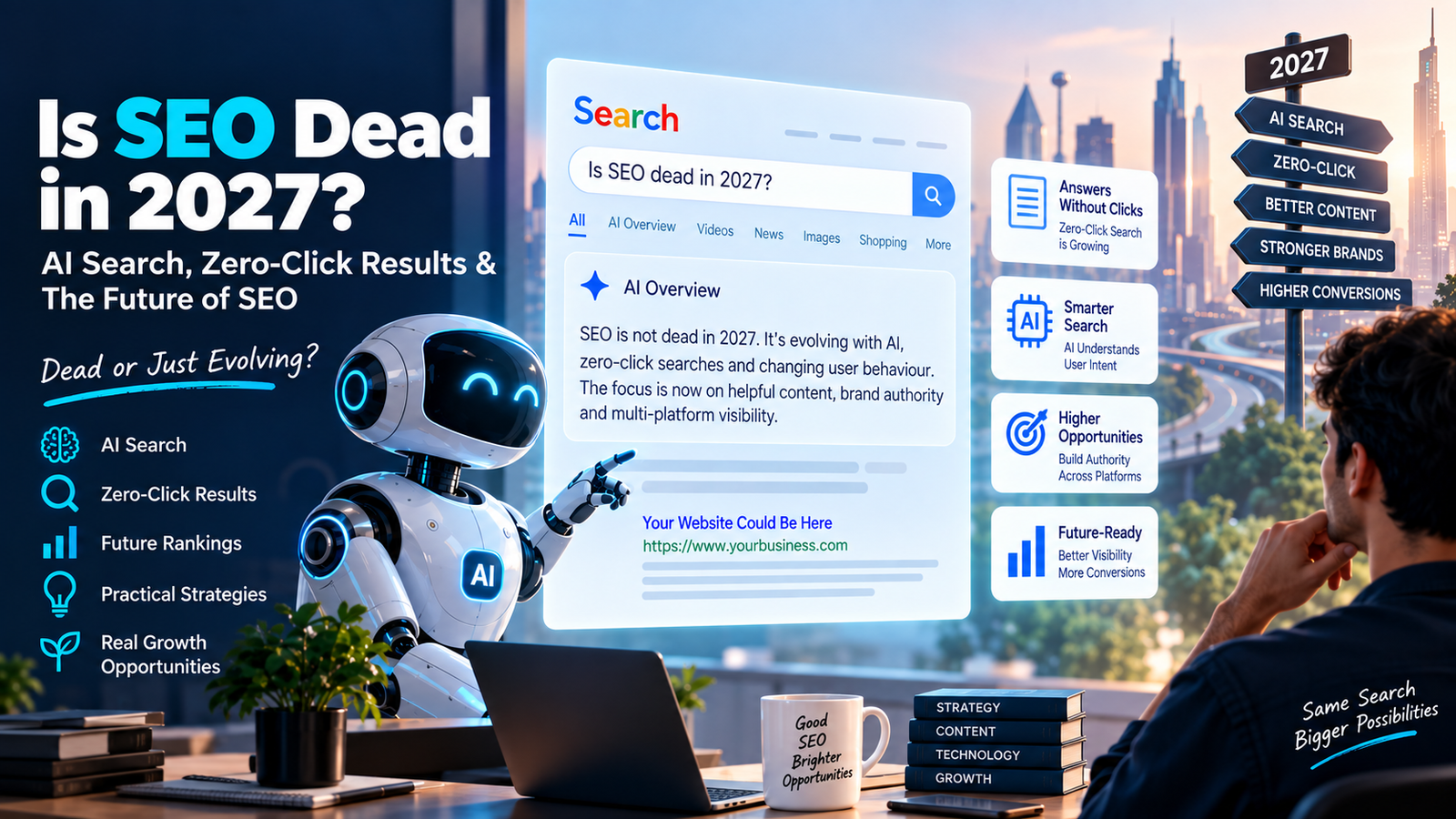
SEO in 2027: Is AI, ChatGPT, and Zero-Click Searches Ruining the Future of SEO?
A common question being asked about SEO in the digital marketing world is: "Is SEO dead in 2027?"
Artificial Intelligence, ChatGPT, Google AI Overviews, AI Mode, and zero-click searches have significantly transformed the search engine experience. Today, users can find answers to every query directly within search results or AI tools. They don't need to click on a website every time.
This is why many businesses and marketers believe that the future of traditional SEO is coming to an end. But the reality is that SEO isn't dead; the process and objective of SEO are evolving.
Earlier, the primary goal of SEO was to rank in Google's organic results. Now, businesses will need to remain visible on Google, as well as on AI-generated answers, conversational search, and multiple digital platforms.
Is SEO Really Dead in 2027?
The simple answer is: No, SEO isn't dead.
As long as users search to discover information, products, services, and solutions, search optimization will remain important.
Yes, the traditional approach to SEO is changing. Simply adding keywords, building backlinks, and ranking on the first page of Google will no longer be sufficient.
Modern SEO will require businesses to focus on these factors:
• Understanding search intent
• Creating helpful and reliable content
• Improving website technical performance
• Building brand authority
• Improving visibility in AI-generated answers
• Converting users to the website
• Maintaining brand presence on different search platforms
In the future, SEO will focus not just on ranking, but on visibility, credibility, traffic, and conversions.
How is AI changing SEO in 2027?
Artificial Intelligence is fundamentally changing search behavior. Users now search for detailed and conversational questions instead of simple keywords.
For example, previously, a user might search:
Best web development company in Delhi
Now, that same user might search:
Which is the most affordable web development company for a small business in Delhi NCR?
AI-powered search tools try to understand the user's question, gather relevant information, and provide a direct answer.
Because of this change, simply optimizing websites for keywords will no longer be enough. Content must be created using natural language, clear explanations, and tailored to user intent.
Important elements of AI SEO include:
• Conversational content
• Question-based headings
• Clear and direct answers
• Structured information
• Original research and practical examples
• Author expertise
• Brand mentions across trusted websites
Google AI Overviews and AI Mode
AI-powered features in Google Search can provide users with direct summaries above traditional blue links.
If a user searches for a topic, Google can collect information from multiple sources and present an AI-generated overview.
In this situation, the user doesn't need to click on a website to get the answer.
But this doesn't mean that the importance of websites has disappeared. AI-generated answers need original sources for reliable information.
The important question for businesses now is:
“Are our website and brand appearing as sources in AI-generated answers?”
To do this, businesses should publish high-quality, well-structured, and trustworthy content.
Including clear definitions, practical examples, relevant statistics, FAQs, and expert insights can be useful in the content.
What Are Zero-Click Searches?
Zero-click search means that users find the answer to their query directly on the search results page and don't click through to any websites.
For example:
• Weather information
• Currency conversion
• Simple definitions
• Business timings
• Basic calculations
• Sports scores
• Short factual questions
AI overviews and featured snippets can further increase zero-click search behavior.
This trend can create a disconnect between organic impressions and website clicks. A website may gain visibility in search results, but users may not visit the website.
Therefore, businesses should not consider organic traffic as the sole metric for success.
How Can Businesses Adapt to Zero-Click Searches?
Even during zero-click searches, businesses can improve their brand visibility and conversions.
1. Improve Brand Visibility
Your brand should appear in search results, whether users immediately click on the website or not.
2. Provide Direct Answers
Provide clear and concise answers to user questions in the opening section of the content. This can help search engines and AI systems understand the content.
3. Use Strong Calls-to-Action
Add relevant calls-to-action to your website, such as:
• Get a Free Consultation
• Request a Quote
• Book a Demo
• Contact Our Experts
• Download the Complete Guide
4. Publish High-Value Content
Create content that users need for detailed information, examples, tools, or professional assistance.
5. Build Brand Trust
Reviews, case studies, testimonials, author profiles, and third-party mentions can help improve brand credibility.
Traditional SEO vs. AI-Powered Search
In traditional SEO, businesses' primary focus was on keywords, rankings, backlinks, and organic traffic.
In the era of AI-powered search, the scope of SEO has become wider.
Now, businesses will have to focus on:
• Search intent with keywords
• Brand mentions with rankings
• Conversions with website traffic
• Brand authority with backlinks
• Search engines with AI platforms
• Direct answers with long-form content
This doesn't mean that traditional SEO techniques are useless. Technical SEO, keyword research, internal linking, quality backlinks, and useful content are still important.
The only difference is that these activities will now have to be part of a broader search visibility strategy.
Will AI-generated content rank on Google?
AI-generated content isn't automatically bad or good. The quality, usefulness, originality, and reliability of the content are more important.
If AI-created content is generic, repetitive, or inaccurate, its performance can be poor.
On the other hand, if AI is used for research, content planning, and editing, and genuine expertise and original insights are added to the final content, it can be useful.
A successful AI-assisted content workflow might look something like this:
1. Identify user intent and target audience.
2. Research relevant topics and keywords.
3. Use AI for outlines and initial ideas.
4. Add personal experience and expert insights to the content.
5. Verify facts and statistics.
6. Have the content reviewed by a human editor.
7. Optimize on-page SEO elements.
8. Update content regularly.
For example, a generic article on “Digital Marketing Tips” may provide limited value.
But if the article contains real campaign examples, budget details, industry-specific challenges, and practical solutions, its usefulness can be significantly improved.
AEO, GEO and AI SEO: What Do They Mean?
Answer Engine Optimization – AEO
The full form of AEO is Answer Engine Optimization.
Its focus is to structure the content in such a way that answer engines can provide direct and clear responses to users' questions.
Useful practices for AEO are:
• Question-based headings
• Short and direct answers
• FAQs
• Structured content
• Clear definitions
• Schema markup, where appropriate
Generative Engine Optimization — GEO
The full form of GEO is Generative Engine Optimization.
Its focus is on improving the visibility of the brand, website or business in AI-generated responses.
To reach GEO, businesses should focus on high-quality content, original information, expert insights and trusted online mentions.
AI SEO
AI SEO is a broader term that describes SEO strategies for AI-powered search environments.
It can include elements such as traditional SEO, AEO, GEO, content optimization, entity understanding, and AI-driven search visibility.
Important Factors for Future Search Rankings
1. Search Intent
Search engines and AI systems try to understand the user's actual purpose.
Therefore, content should be created according to informational, commercial, navigational, and transactional intent.
2. Helpful and Original Content
Content should contain real value, practical examples, accurate information, and original insights.
Instead of simply rewriting existing articles, businesses should share unique experiences and knowledge.
3. Technical SEO
Technical SEO will remain important in future also.
Important areas include:
• Website loading speed
• Mobile responsiveness
• Core Web Vitals
• Crawlability
• Indexability
• XML sitemap
Canonical tags
• Secure HTTPS connection
• Clean website architecture
4. Brand Authority
Strong brands can be trusted more by both users and search systems.
Businesses should build authority through mentions, reviews, digital PR, expert contributions and quality backlinks on relevant websites.
5. Multimedia Content
Search behavior isn't limited to text alone.
Videos, images, infographics, podcasts, and social media content can also play an important role in brand discovery.
6. User Experience and Conversion Rate
Driving traffic to a website isn't enough. Converting users into customers is also important.
Businesses should improve:
• Website navigation
• Page design
• Contact forms
• Landing pages
• Mobile experience
• Calls-to-action
• Trust signals
How to Build a Future-Proof SEO Strategy
To create an effective SEO strategy in 2027, businesses should follow the following steps:
Step 1: Perform a Technical SEO Audit
Check website speed, indexing, broken links, mobile usability, and technical errors.
Step 2: Develop a Topic-Based Content Strategy
Instead of focusing solely on individual keywords, create complete topics and topic clusters.
Step 3: Write Search Intent-Based Content
Every page should address a specific user need.
Step 4: Publish Expert-Led Content
Include real experiences, case studies, original opinions, and practical examples.
Step 5: Add FAQs and Structured Information
Clearly answer common user questions. Implement appropriate structured data on relevant pages.
Step 6: Improve Brand Mentions
Build brand presence through industry directories, guest contributions, PR campaigns, reviews, and relevant third-party platforms.
Step 7: Monitor AI Search Visibility
Regularly check the context in which AI-powered search tools are mentioning your brand.
Step 8: Track Performance
Monitor these metrics to evaluate SEO performance:
• Organic impressions
• Organic clicks
• Keyword visibility
• Branded searches
• Referral traffic
• Leads and sales
• Conversion rate
• Engagement
• AI search mentions
Example: Web Development Company in Delhi NCR
If you run a web development company in Delhi NCR, simply targeting the keyword “web development company in Delhi” won't be enough.
You should create content tailored to different user needs, such as:
• What is the cost of website development in Delhi?
• Which website is best for small businesses?
• What are the benefits of Laravel website development?
• What is the difference between React and WordPress?
• How to develop an e-commerce website in Delhi NCR?
• Why is SEO important for a business website?
You can create case studies, pricing guides, service pages, FAQs, comparison articles, and industry-specific landing pages.
This strategy can improve your chances of becoming a relevant information source in both traditional search results and AI-powered search.
Common SEO Mistakes to Avoid in 2027
Businesses should avoid some common mistakes in their future SEO strategy:
• Focusing solely on keyword density
• Publishing low-quality AI content
• Not updating content regularly
• Ignoring technical SEO
• Overlooking the mobile experience
• Purchasing fake backlinks
• Ignoring search intent
• Not focusing on brand building
• Considering only traffic as a success metric
• Adding inaccurate information to content
SEO is a long-term process. Consistent content, technical improvements, and continuous performance analysis can provide more sustainable results.
Frequently Asked Questions
Is SEO dead in 2027?
No. SEO isn't dead, but its approach is changing. Businesses will have to optimize for AI-powered search platforms in addition to traditional search engines.
Will AI replace SEO?
AI may change the workflow of SEO professionals, but strategy, user research, technical expertise, content quality, and business understanding will remain important.
What is the future of SEO?
The future of SEO will depend on search intent, helpful content, technical performance, brand authority, AI search visibility, and conversions.
Is AI-generated content good for SEO?
AI-generated content can be useful when it is accurate, original, helpful, and properly reviewed. Simply publishing large-scale automated content is not an effective strategy.
What is GEO in digital marketing?
GEO stands for Generative Engine Optimization. Its focus is on improving the visibility of brands and websites in AI-generated answers.
SEO Is Evolving, Not Dying
The future of SEO is not going away. The nature of search is changing.
Successful businesses in the future will be those that don't rely solely on Google rankings. They will simultaneously focus on strong content, technical SEO, brand authority, AI search visibility, and conversion optimization.
In 2027, the goal of SEO won't just be to drive traffic to your website. The goal will be:
"Whenever a potential customer searches for a question related to your business, your brand should appear as the source of trusted information and a relevant solution."
At Hash Digitech, we support businesses with online growth through SEO, GEO, AEO, Google Ads, Meta Ads, website development, and performance-driven digital marketing strategies.
If you want to improve your business's search visibility, you can start with a comprehensive SEO and AI search optimization strategy.