Why the EV Industry Needs a Smarter Digital Marketing Strategy
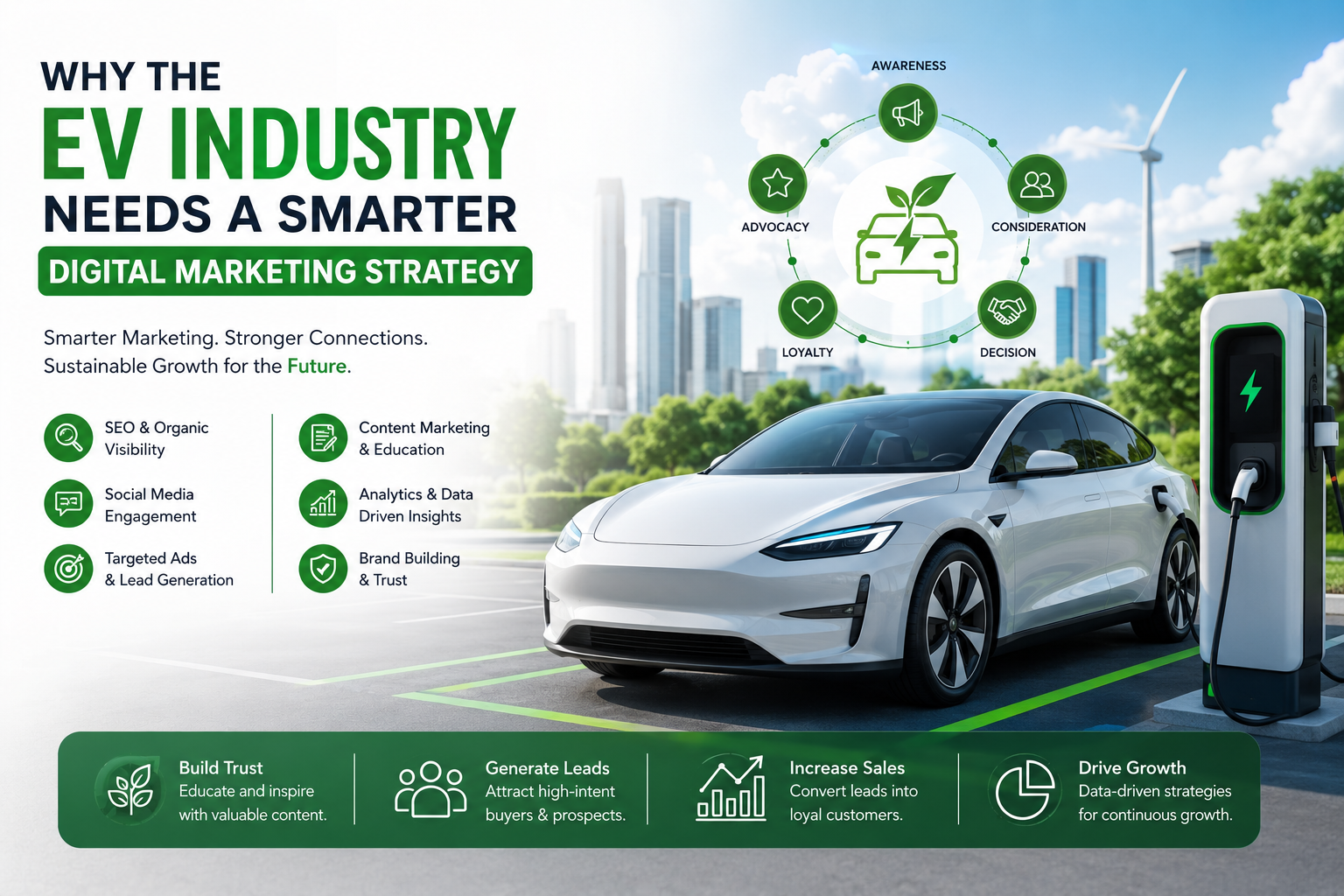
Electric vehicles (EVs) are transitioning from the margins of the automotive industry into a significant segment of the global automotive industry. EVs, e-scooters, motorcycles, buses, commercial vehicles, charging stations, batteries and related technologies are becoming more intriguing to consumers and business.
But the development of a terrific EV product isn't sufficient. Today's consumers do a lot of research before buying something. They research the specifications, range, charging time, running costs, government incentives, user reviews, financing solutions and competing brands online. Therefore, digital visibility plays a significant role in the growth of EV businesses.
For EV manufacturers, dealerships, charging companies, battery manufacturers, and mobility startups, having a smarter online strategy can help transform awareness into qualified leads and eventually customers.
The EV Buying Journey Starts Online
In the old days, marketing of the cars was very dependent on the dealerships, print ads, outdoor ads, TV, and direct sales. They remain relevant but the customer journey has evolved considerably.
A potential EV buyer may first search for:
Best electric cars in their budget
Electric scooter range and price
EV charging stations near me
EV battery warranty
Electric vehicle maintenance cost
EV comparison with petrol vehicles
Government EV subsidies
Best EV for city driving
The customer can see several websites, view YouTube videos, social media reviews, customer reviews, and competition before reaching out to dealerships.
Thus, EV companies must be involved in the entire research process and not just when the car is ready for sale.
EV Customers Need More Education
There's a lot of education that's different between EV marketing and auto marketing.
However, there are still many potential customers who have questions regarding battery degradation, charging infrastructure, range anxiety, charging costs, maintenance, resale value, safety, and long battery life.
These worries can be addressed in a smarter content strategy, before they start to become objections.
For example, an EV brand could publish content such as:
How much does it cost to charge an EV?
How long does an EV battery last?
EV vs petrol car: Which is more economical?
How to choose an electric scooter?
Home EV charging: A beginner's guide
What is regenerative braking?
How does EV battery warranty work?
A Home EV charging: A beginner's guide is available.There is a Home EV charging: A beginner's guide.
What is the use of the Regenerative Braking System?
What does EV battery warranty entail?
Educational content helps to create familiarity and brand itself as a knowledgeable information source as opposed to just another company that sells vehicles.
Search Visibility Is Critical for EV Brands.
Product discovery is crucial and a search engine is a significant factor in it. Brands who regularly deliver helpful and relevant information have a chance to enter the customer's consideration set when they are looking for information about EVs.
The goal of an effective search strategy is to include both informational and commercial searches and transactional searches.
For instance, an EV company can develop content based on general questions and concerns, as well as optimize product pages for product-specific searches, such as specific models, features, locations, and use cases.
For dealerships and charging infrastructure providers, local search plays an especially significant part. When a customer wants to find an EV showroom, service centre or charging station, they tend to have a high level of purchase or usage intent.
That is where the Digital Marketing Company can assist an EV organization with creating a strategy that incorporates search positioning, content, paid promoting, social media, and conversion optimization.
Social Media Can Demonstrate the EV Experience
Platforms like Instagram, Facebook, YouTube, and other video platforms are useful in raising awareness for EV products as they are highly visual and experiential.
Instead of publishing only promotional advertisements, EV brands can create content around real experiences.
For example:
EV test-drive videos
Range tests
Charging demonstrations
Customer stories
Product walkarounds
Feature explanations
Battery technology explainers
Road-trip content
Maintenance tips
Behind-the-scenes manufacturing content
Short-form video may be an effective way to explain complex technologies. A short video that shows how fast a car can charge can convey more information than a lengthy description.
Customer generated content can also build trust, as potential customers will be able to see how real customers use the product.
Paid Advertising Can Accelerate EV Lead Generation.
Getting organic visibility can be a time-consuming process, but paid advertising can help businesses target relevant audiences more quickly.
Search advertising can help EV companies get users that are actively searching for EVs, charging infrastructure, batteries, or EV dealerships. Social advertising can be used to help raise awareness, build consideration, remarket and generate leads.
For instance, a campaign might be targeting those who have been on a certain vehicle page but haven't sent an enquiry. They can then be shown a test-drive offer or in-depth product information in a remarketing campaign.
But impressions or clicks aren't the only things advertising should be about. To make advertising more relevant to actual business goals, EV companies should link ads to meaningful business metrics like:
• Test-drive bookings
• Dealer enquiries
• Brochure downloads
• Finance enquiries
• Charging station registrations
• Product enquiries
• Qualified leads
• Vehicle purchases
This can enable businesses to determine if they are getting return from their marketing investment or not.
Data should be used to guide marketing decisions.
It is possible to enter the EV market in a very competitive manner and the assumptions can cost you dearly! Companies require dependable data to determine what their customers are looking for, which campaigns lead to leads, and which pages lead to conversions.
Analytics can provide useful data like:
Which channels are the best for quality leads?
Which products are most interested?
What are the words that are sure to draw in potential buyers?
Which pages of your website do visitors end up on?
• How much does each qualified lead cost?
• What audience segments are successful?
Where does the potential customer drop off on the conversion journey?
The insights help marketing teams to continually enhance their campaigns rather than shooting in the dark.
Therefore, a well-crafted Digital Marketing services strategy ought to incorporate the execution of the campaigns, measurement, analysis, experimentation, and optimization.
Personalization can enhance the Customer Experience.
For urban commuters, charging convenience and cost might be more important, but for long-distance travelers, range and charging stations could be a primary concern. A fleet operator might be more interested in overall running expenses, uptime and fleet management.
Digital platforms enable EV companies to develop multiple messages for multiple targets.
For example:
For individual buyers:
Highlight range, features, comfort, savings and ownership experience.
For fleet operators:
Concentrate on operating cost, efficiency, reliability and fleet economics.
For charging businesses:
Consider charging speed, network access, location and technology.
Such segmentation can make marketing communication much more relevant.
Having a strong landing page is essential for EV companies.
Having visitors to your generic home page isn't necessarily sufficient.
Each big campaign should ideally drive users to a landing page that is relevant to said campaign. An EV manufacturer selling a particular model might develop a separate page with:
• Product specifications
• Battery information
• Driving range
• Charging details
• Pricing
• Financing options
• Images and videos
• FAQs
• Customer reviews
• Test-drive CTA
The page should have answers to the user's key questions, and there should be a clear next step.
Local dealerships can also have location-specific information, inventory, contact details and directions on landing pages.
Building Trust Is Essential in the EV Market
When considering a purchase of an EV, there are big money values involved. Consumers are thus required to have trust in the company, technology, warranty, service network and long-term support.
Exaggerations should not be used in digital marketing, but rather evidence.
Helpful trust indicators:
• Genuine customer reviews
• Product demonstrations
• Transparent specifications
• Warranty information
• Service centre details
• Certifications
• Expert explanations
• Case studies
• Real-world performance data
An online presence that is transparent can alleviate uncertainty and help customers transition from research to enquiry.
A Smarter Digital Strategy Generates Long-Term Growth
The EV sector is rapidly changing. New brands are coming in, new technology is being developed, the number of charging stations is growing and expectations are evolving.
Digital marketing is not about advertising and for businesses that have to work in this kind of environment, they shouldn't consider it as such. It should be a cohesive growth system, meaning that it should work together between awareness, education, lead generation, customer engagement, and retention.
A Digital Marketing company can help EV businesses unify these channels with a strategy that aligns with the products, audience, competition, and growth goals.
Likewise, with the right Digital Marketing services, an EV brand can boost its search engine visibility, connect with pertinent customers through paid media, establish trust with their audience with content and turn online traffic into tangible business opportunities.
The mobility landscape too is increasingly getting electric and so is the competition inside the EV ecosystem. If customers are unable to find, comprehend, compare, and trust the products offered by a company online, then the company can have a hard time competing and standing out.
By using a smarter digital marketing approach, EV companies can educate customers, capture high intent searches, showcase products with engaging content, target specific customers, create qualified leads and leverage data to continually refine performance going forward.
The opportunity is not simple the sale of an EV, for EV manufacturers, dealerships, battery companies, charging networks, or mobility startups. It's all about creating a digital customer journey that will make it easier, simpler and more attractive to choose that vehicle.